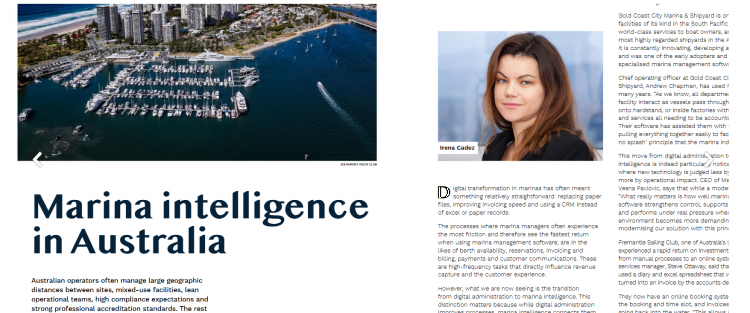
Australian operators often manage large geographic distances between sites, mixed-use facilities, lean operational teams, high compliance expectations and strong professional accreditation standards. The rest of the world can learn a lot from their experiences of adopting the latest generation of marina digitalisation.
by Irena Cadez
Digital transformation in marinas has often meant something relatively straightforward: replacing paper files, improving invoicing speed and using a CRM instead of excel or paper records.
The processes where marina managers often experience the most friction, and therefore see the fastest return when using marina management software, are in the likes of berth availability, reservations, invoicing and billing, payments and customer communications. These are high-frequency tasks that directly influence revenue capture and the customer experience.
However, what we are now seeing is the transition from digital administration to marina intelligence. This distinction matters because while digital administration improves processes, marina intelligence connects them. It creates a live operational environment where berths, customers, contracts, payments, utilities, movements, compliance records, access, reporting and customer communications sit within a single, trusted system.
“No cash, no splash”
With the average Australian marina boasting 86 percent occupancy and accommodating approximately 182 vessel storage spaces, not even to mention the host of other activities going on in any given facility, Australia needs quality marina management software.
Gold Coast City Marina & Shipyard is one of the largest facilities of its kind in the South Pacific built on providing world-class services to boat owners, and is one of the most highly regarded shipyards in the Asia-Pacific region. It is constantly innovating, developing and expanding, and was one of the early adopters and beneficiaries of specialised marina management software.
Chief operating officer at Gold Coast City Marina & Shipyard, Andrew Chapman, has used Marina Master for many years. “As we know, all departments across a large facility interact as vessels pass through berths to lifts and onto hardstand, or inside factories with different goods and services all needing to be accounted for,” he said. Their software has assisted them with the problem of pulling everything together easily to facilitate the ‘no cash, no splash’ principle that the marina industry is based on.
This move from digital administration to marina intelligence is indeed particularly noticeable in Australia, where new technology is judged less by novelty and more by operational impact. CEO of Marina Master, Vesna Pavlovic, says that while a modern look can help, “What really matters is how well marina management software strengthens control, supports decision-making and performs under real pressure when the operational environment becomes more demanding. We are modernising our solution with this principle in mind.”
Fremantle Sailing Club, one of Australia’s largest ocean clubs, experienced a rapid return on investment after moving from manual processes to an online system. Their boatyard services manager, Steve Ottaway, said that they previously used a diary and excel spreadsheet that would then have to be turned into an invoice by the accounts department.
They now have an online booking system that generates the booking and time slot, and invoices clients prior to going back into the water. “This allows us to have a history on boats at a click of a button and also allows mapping of a boatyard,” Ottaway said. “It also allows the boatyard to receive insurance and registration prior to lifting, saving endless hours on manually entering the bookings.”
CRM for decision-making
Much of this progress has to do with the role of the customer relationship management (CRM). In earlier systems, CRM functioned primarily as a record-keeping tool, but in new models CRM becomes a decision-making layer where historic behavioural data, booking history, payment patterns, berth usage and service preferences can be combined with live operational inputs.
Shellharbour Marina in New South Wales is one of Australia’s newest lifestyle boating destinations and is managed by Marine Holdings Australia, a company with decades of experience in developing and running world-class marinas. A marina of this kind depends on strong and reliable operational support behind the scenes.
Their marina manager Jarvis Binkin says that moving to a cloud-based marina management system has allowed their team to access the system remotely and manage day-to-day activities with much greater visibility and flexibility. “We’ve also integrated wireless power metering across the marina, with usage from the Widesky platform feeding directly into Marina Master,” he said. “This has reduced manual administration and improved billing accuracy. The system also makes managing new bookings seamless and straightforward, which is important with our high level of casual visitation.”
Meanwhile, Lorraine Yates, the general manager at Sydney’s most awarded boat maintenance facility, White Bay 6, says that their marina management software has improved efficiency, strengthened data management and given their team greater visibility across many aspects of the business. “Importantly, the platform continues to evolve, with regular updates and improvements that reflect the changing needs of marina operators,” she says.
Rental pool revenue
Another innovation a marina can offer to its clients is a rental pool module, enabling passive income for berth owners. The rental pool module allows multiple berth owners to combine their individual berths into a collective pool, which is managed and rented out by the marina. The marina handles all aspects of marketing, maintenance and guest bookings, while rental income is pooled and distributed among participating owners based on berth size and the number of days each berth is available for rent. The marina retains a portion of the income as management fees and applicable levies.
Lea Griffiths, business manager at North Harbour in Queensland, comments: “Since the conception of Mackay Marina some 25 years ago, we have offered our berth owners a return-on-investment opportunity through our rental pool, renting pooled berths and paying owners quarterly on a metered night rate formula. Berth owners can participate for days, weeks, years or move in and out of the pool for complete flexibility.
“Recently, we decided to take this long-standing process into the digital age. Our desire was to move our manual rental pool system, previously spread across an outdated CRM, multiple spreadsheets and a separate accounting software, into one seamless programme. As we began unravelling the network of old interfaces, we quickly realised the scale of the challenge.
“This tailored solution gives berth owners an easy-to-use digital form to join or exit the pool on their preferred timeline. The system automatically submits berths for rental listing, calculates the formula for pooled income, considers the tax implications and manages quarterly distributions, all within a single programme,” says Griffiths.
Access, control and customer service
Southport Yacht Club, the Gold Coast’s award-winning premier sports club, is known for its exceptional sailing and powerboat fraternities, award-winning boating facilities and exceptional and exclusive waterfront dining. Their waterfront manager, Mark Riddell, says that “Being able to have one system that does everything - bookings, reporting, client and vessel information and facial ID for access control, all in the owners’ files - is so convenient.”
After all, Southport Yacht Club is home of Australia’s spectacular offshore sailing regattas and fastest growing ocean race, and offers a wide range of function spaces, sailing programmes, events and training. This requires a strong and reliable digital management system as well as marina intelligence that connects operations and helps keep everything running smoothly. Southport Yacht Club was also an early adopter of Marina Master’s faceID, which simplifies staff and customers’ access to the marina, dry storage or boatyard facility.
Smarter marina management can positively impact customer experience in other ways too. Marina client portals can enable customers to request reservations, assistance and a live feed of their vessel, and customers can pay online quickly and easily, and utility invoices can be issued in one click. These improvements are practical but they also fundamentally change and improve the customer experience.
If these advancements are merged sensitively with the overall customer experience and “human touch” that defines many marinas, technology can protect hospitality rather than undermine it. By reducing repetitive administrative tasks, marina teams can then focus on safety, service quality and personal engagement.
Lessons learned
There are very many different marina management solutions on the market, and their number is still growing. In any case, the lessons learned from Australian marina operators on the benefits of adopting next-generation software are clear.
Across Australian marina groups and operators, staff have noted significant improvements in day-to-day operations and cost savings. Reduced billing errors, consistency of reporting, standardisation of data and clearer audit trails can translate into further gains in maintenance and asset tracking, resource allocation and smoother workflows.
The most valuable shift occurs when connected workflows begin generating structured, reliable data that help marinas understand how they can operate their facility better. The Australian market is distinguished by a very high quality of service and facilities, and therefore customer, vessel, berth, contract and asset records must be standardised. Without this, reporting and forecasting become weak and fragmented, ultimating affecting revenue. Done well, these connected workflows help to plan pricing, capital and staff allocation.
With utilities, a strong initial approach is to first stabilise meter readings and billing, and then use the data gathered across the site to reduce exceptions. Once there is a reliable baseline, rules-based alerts can help identify problems and give both staff and customers more transparency and confidence in billing procedures. The same approach can be applied to fuel, sensors, access and security.
What’s more, solutions must be flexible instead of rigid, and should be open and able to grow together with the marina’s goals, needs and wider industry trends. Integrating and implementing requirements is usually only a question of time and resources if the will to do so is there.
Marina intelligence gives a real-time view of what’s happening in the marina and connects insights from the past with what’s coming next. It brings together day-to-day operations and valuable data in one place so marina staff can optimise processes and make better decisions with greater confidence, ultimately to the benefit and satisfaction of the customer. The real advantage of the next generation of marina management software is in owning your data, trusting it and knowing how to use it in the right way.
According to Tone Britovsek, owner of Marina Master: “There are no two marinas working the same way. Each marina has its own soul and its own way of working. However, one thing that all marinas do have in common is the need for an all-in-one system where office processes and dockside operations work as one and, wherever possible, evolve into marina intelligence.”
Marina Master in Marina World, Issue 153, page 40-44